Access management has to catch up with the agentic transformation.

An agentic organization is one in which AI agents do most of the execution, while people supervise, decide, and handle the exceptions.

Access was hard long before the first agent. IT and security teams have kept it working through a ticket queue that never empties, joiners, movers, and leavers (JML) tracked in spreadsheets, and audits rebuilt by hand for every certification. What held it together was the care of a few people who knew why each grant existed.

Then teams add agents to move faster, and the work stalls wherever it waits on a resource or on access. A team that is already stretched can’t absorb that by working harder.

Accession1 is self-service provisioning of resources and access for people and AI agents. Administrators set the boundaries, teams and their agents serve themselves inside them, and Accession1 applies every change to every target system. Its access graph takes the place of runbooks and access documentation, because it acts on every change instead of waiting for someone to read it. That puts IT and security in control, so they can tighten the security of what runs today and say yes to agents when the business is ready.

Why it's urgent Identity governance built for human speed breaks at agentic speed.

IT and security run these processes by ticket, export, and runbook, and they barely kept up before agents. Agents add identities and changes faster than any of the three can follow.

Configuration drift Every certification starts from a drifted export.

Correct access depends on knowledge spread across a team, but each ticket goes to whoever is on rotation. Access shared by hand in a target system has no rule behind it, so a reviewer certifying it later can’t tell why it exists. The certification is rebuilt from exports each quarter, and approving what nobody can explain becomes the safe choice.

In Accession1 user access reviews certify the rules behind every grant, and each change is applied everywhere.

Provisioning bottleneck Work waits on the resource and on the access.

Work needs a resource and the access to it, and the ticket queue handles them as two requests. A launch waits for its repository and then for each teammate’s access, and a team adding agents to move faster stalls at the same step.

With Accession1 workspace members provision a resource and its access in one step through IT self-service.

Agentic overhead Agents bring large-organization lifecycle work.

Joiners, movers, and leavers used to be a large-organization concern, because a small team could rely on a circle of trust. Agents are added per project, workflow, or task, and they move and retire just as often. So a small team now carries the lifecycle work of a much larger one.

Accession1 helps you automate every joiner, mover, and leaver for people and agents alike.

Privilege creep Agents exercise what people left unused.

Excessive permissions accrued because restricting access by ticket was slow, and for people the residual risk often stayed within tolerance. An agent following an injected instruction can exercise a grant the person it runs as never used, so that tolerance no longer holds.

Using Accession1 you apply least privilege to people and agents, and grant elevated access temporarily on request.

Tool sprawl Every agentic control adds a policy format.

Agentic AI introduces risks that call for new controls, such as MCP gateways and agent monitoring. Each comes with its own permission model and policy format. IT and security add them to a stack that is already complex, and keep every format consistent by hand.

In Accession1 you govern existing and new tools from one access graph.

Why self-service A faster queue is still a queue.

Self-service developer platforms took the wait out of software delivery. Agents ask the same of every function, for the same reason.

  1. 01Software delivery, then Waiting held delivery back.

    When software delivery had to move faster, days spent waiting for a server or for access to one held every team back. Organizations built self-service developer platforms, with IT and security helping to build them, so teams got resources and access inside limits a platform team set.

  2. 02Every function, now Agents bring the same pressure.

    Finance, sales, support, and legal add agents to move at the same speed. Their work now waits on resources and access the way software delivery once did, and a ticket queue can’t keep up with either.

  3. 03The trap An agent on the queue only answers sooner.

    Putting an AI agent on the queue closes tickets faster. But each ticket still ends in a static grant, and the access drifts from the work the same way.

  4. 04With Accession1 Self-service inside your rules.

    Teams and their agents provision resources and access themselves, the way software teams do on a developer platform. Administrators decide what each workspace may use, and nothing a team creates reaches past that.

For IT and security The speed every team wants, with control you can prove.

IT and security ran access across separate systems that never shared one view of it: the identity provider, the ticket queue, a governance tool, and each target system’s console. Accession1 brings that work onto one access graph, so they set the rules and say yes at the pace of self-service.

Order from what you know
Your team codifies its spreadsheets, runbooks, and experience into your organization’s context with the AI assistant’s help, and designs the access graph from it.
Resource and access provisioning in one step
Teams and their agents provision a resource and the access to it together, so routine requests leave your queue.
Deterministic
The same identity, resource, and policy state always produces the same grants. AI never decides a grant.
Current on any day
Access ends with its reason in every target system, and the record an auditor asks for is ready whenever they ask.

Use cases IAM and identity governance processes, ready for AI agents.

AI agent access control, joiners, movers, and leavers, least privilege, access reviews, compliance controls, and IT self-service were built for people at human pace. Every use case sets current practice beside Accession1’s approach and the load it takes off IT and security.

The product Administrators design, teams serve themselves, and Accession1 reconciles.

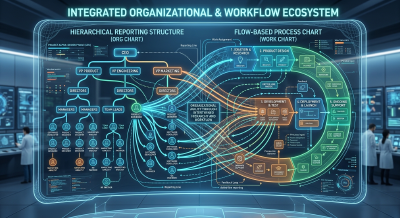
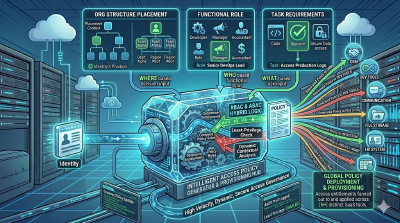
Accession1 sits between your identity provider and your target systems. In context-aware design, administrators codify your organization’s context with the AI assistant’s help and set the boundaries of each workspace. In self-service provisioning, workspace members provision resources and access inside those boundaries. Then continuous reconciliation applies the result to every target system on every change.

Self-service resource and access provisioning

Frequently asked questions Agentic organization FAQ

What is an agentic organization?

It’s an operating model where people supervise AI agents that do most of the execution, and step in to decide and to handle the exceptions. For access, it means many more identities and many more changes to them.

How does identity and access management change with AI agents?

Agents add identities that join, move, and leave far more often than people do, and they need resources and access as fast as they work. So the processes IT and security run, from agent identity and joiners, movers, and leavers to least privilege, access reviews, and compliance controls, have to act on every change instead of on every ticket.

Is Accession1 only for agentic organizations?

No. The ticket queue, configuration drift, and the audit rebuilt from exports are worth fixing at human speed too. Agents make them urgent, because they add identities and changes faster than a queue can follow.

Can't an AI agent answer our access tickets instead?

It would answer them faster, but it’s still a queue. Each ticket still ends in a static grant that stays until someone requests its revocation, so access drifts from the work as before. In Accession1 access policies match identities and resources by label, and continuous reconciliation applies them on every change, so access stays dynamic instead of static.

What is tool sprawl, and why does agentic AI make it worse?

Tool sprawl is the stack that grows one tool per problem, each with its own console and its own policy model. Agentic AI introduces risks that call for new controls, such as MCP gateways and agent monitoring, and each brings a policy format of its own to keep consistent with the rest. Accession1 integrates the tools you run and the ones you add, and governs them from one access graph.

Who is Accession1 for?

IT and security leaders accountable for identity and access while the organization adopts AI agents, from the first pilot to agents in every function. It gives them one access graph to set policy on, a record auditors can read on any day, and a way to approve agents without growing the ticket queue. The teams rolling agents out get the resources and access they need inside those policies.

Is Accession1 an identity governance (IGA) tool?

Accession1 combines the capabilities of identity governance and administration (IGA) and IT self-service. It governs the access to the target systems it manages and provisions the resources in them, which governance tools leave to a ticket. Why the two belong in one product is the argument of IT self-service.

From the blog Posts on the agentic organization.

All posts