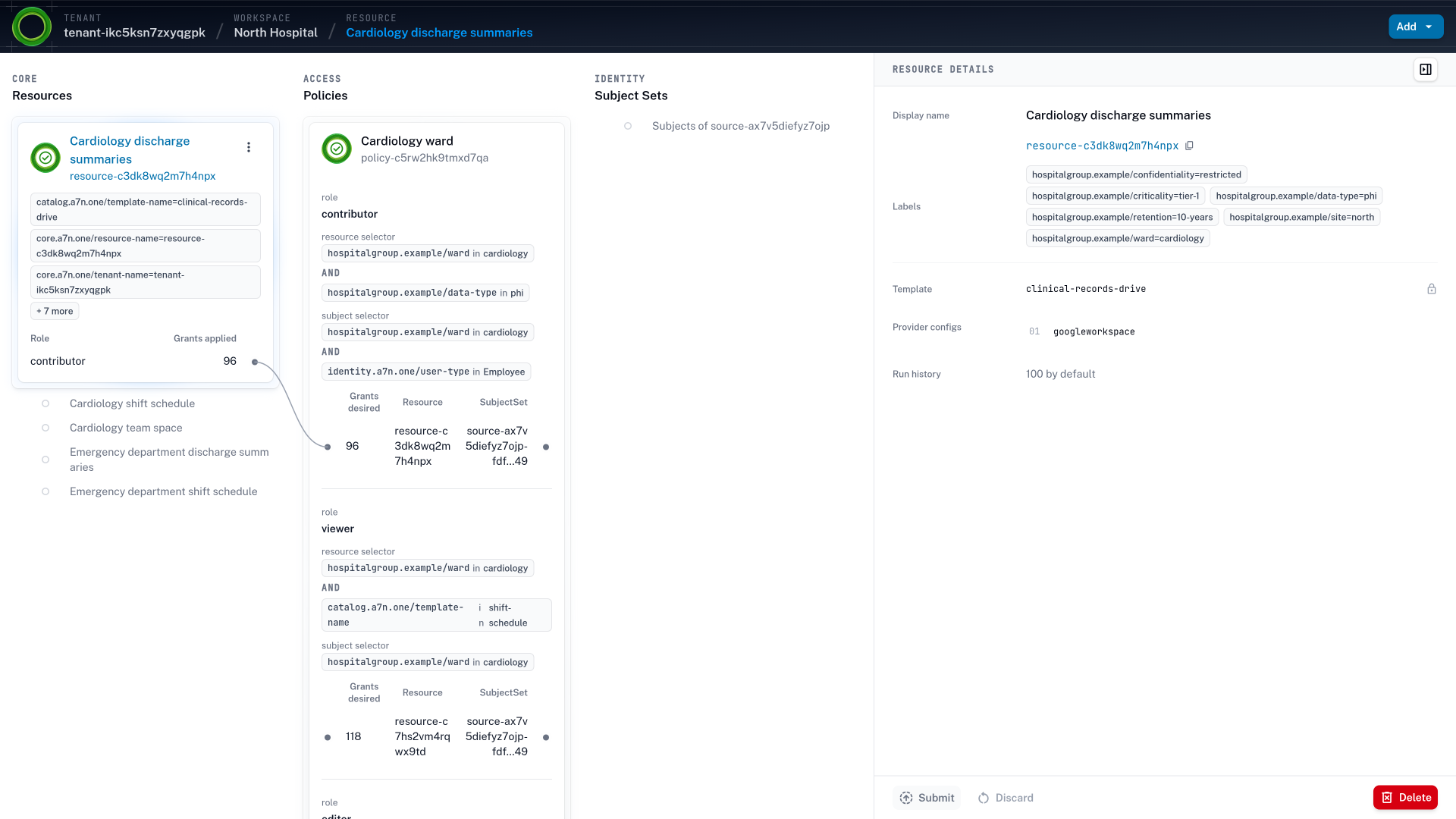
The North Hospital workspace of Example Hospital Group in Accession1, with the cardiology discharge summaries selected among the ward's resources, showing its restricted, tier-1, and phi labels, its 96 contributor grants, the Cardiology ward access policy beside it, and the identity source that exports the hospital's 1,420 people
The cardiology ward at Example Hospital Group keeps its discharge summaries in a drive of their own, labeled phi and restricted, apart from the shift schedule and the team space. The Cardiology ward access policy gives the ward's 96 employees the contributor role on the summaries and the 22 agency temps nothing there, while everyone on the ward reads the schedule.

Two sides Every new team tests the balance between compliance and speed.

  1. Designing it Thirty pages of rules.
    One access policy at a time.

    A regulation never names your departments, so mapping each of its controls to access is a judgment call. An IAM lead at a bank turns the bank’s information barrier policy and MiFID II into access policies about who may open which folder. It takes a quarter, and a week later a reorganization renames two departments.

    In Accession1 an administrator makes each judgment call once, on drafts the AI assistant writes from your compliance requirements.

  2. Maintaining it Compliant in January.
    A new team in March.

    Every change to the organization has to be assessed against the controls again, by hand. A security analyst runs a compliance review for each new team, drive, or contractor cohort as a ticket. Each one waits its turn, and the business reads the wait as security saying no.

    With Accession1 your team keeps the controls in the access policies, and each change is checked against them the same day.

  3. Agents added Ten agents by summer.
    All of the excess exposed.

    Excessive permissions were a residual risk while only people held them, because a person rarely touches them. An operations team adds an agent to match trade confirmations, and the agent can exercise every permission its role carries. In a regulated sector, one wrong call can be a reportable breach.

    Accession1 helps you give each agent its own identity and the roles its place and purpose call for.

How it works Compliance requirements in every access policy a team writes.

  1. Step 1: The context records your regulatory obligations

    The assessment collects which regulations apply to which legal entity, jurisdiction, and category of data, from public research. Your team sharpens it with what only your people know, so the requirements are facts the design rests on instead of a document someone has to remember.

  2. Step 2: Administrators draw the boundaries

    Administrators draw the workspaces along the information barriers and legal entities your regulation names, with the AI assistant drafting from the context. They set a risk tier per template and the label taxonomy with the data types it covers, and decide what each workspace may provision.

  3. Step 3: Teams serve themselves inside them

    Workspace members can’t be expected to be IAM experts. They say what a resource is for and who needs access to it, in business terms, and the AI assistant drafts the access policy from the same context. The policy respects the regulation without anyone looking it up.

  4. Step 4: Continuous reconciliation applies it on every change

    Identities arrive with their attributes as labels. The AI assistant suggests the labels a template needs when administrators create it, and the labels a resource needs when a workspace member creates one from it. Reconciliation grants where both sides match and revokes on every change.

Compliance reviews can’t keep pace with AI agents

IT and security teams in a regulated sector carry a balance nobody else sees. On one side is a framework whose every requirement has to be met and evidenced: MiFID II, HIPAA, GDPR, PCI DSS, export control, or the rules of professional conduct. Each requirement has to be read against your own departments, drives, and contractors before it says who may open what. On the other side are the initiatives waiting, and a request that waits two weeks for a compliance review reads to the business as security saying no. Keeping the design compliant as the organization changes falls to the same few people, ticket by ticket, with the audit as the only check. Agentic AI adds weight to both sides. Every agent a team adds needs an identity, a boundary, and an access policy inside the same compliance requirements, in days rather than quarters. And an agent that hallucinates or follows an injected instruction can exercise the excessive permissions a person would rarely touch.

Accession1 is self-service provisioning of resources and access for people and AI agents. Administrators write your compliance requirements into its boundaries, teams serve themselves inside them, and Accession1 keeps every grant within those requirements as the organization changes.

Administrators map regulatory obligations into the design

Accession1 records which framework applies to which legal entity, jurisdiction, and category of data as part of the context, from public research refined with your team’s institutional knowledge. From it the AI assistant drafts, and administrators approve, the workspaces along your information barriers and legal entities, a risk tier for each template, and what each workspace may provision, through context-aware design. Each agent is placed in one of those workspaces, so it starts inside the same boundary as the people it works for.

Self-service inside your compliance controls

Self-service in a regulated sector has two challenges a faster queue doesn’t solve. The first is the configuration: a drive for client transaction data needs the retention, sharing, and archiving settings the regulation requires, and each target system needs a template that gets them right. The second is the access policy, which depends on the regulation and on the people: their legal entity, their employment type, or the side of an information barrier they work on. Writing it takes someone who knows the rules, and each agent a team adds needs both in days, often in a system without a template yet.

In Accession1 a workspace member says what the resource is for and who needs it, in business terms, through self-service provisioning. The AI assistant drafts the access policy from the same context the administrators designed from, and the template carries the settings the regulation requires. A new target system joins through an OpenTofu module instead of a project, so the effort doesn’t grow with every system a team or its agents ask for.

Compliance labels on every identity and resource

Identities arrive from the identity provider with their attributes as labels, such as the legal entity, the department, the employment type, or the client engagements a person works on. Every resource carries confidentiality, criticality, and a data type such as personal data, health data, or card data, and your sector adds its own, such as a jurisdiction or an export control regime. The AI assistant suggests those labels when a template or a resource is created, and proposes the label queries of each access policy in the regulator’s own terms. Continuous reconciliation grants where the labels on both sides agree and revokes the moment they stop, in every target system, for people and agents alike. The risk tier of a resource holding regulated data narrows what an agent may hold there, down to no role at all. The record of every grant names the labels that justify it, so the audit evidence is current on any day.

Data segregation in dedicated resources

Many regulations ask that certain data live apart: card data, patient records, privileged communications, or export-controlled drawings, in a resource of their own with access narrower than the team’s. By ticket the second drive, its access policy, and its classification are separate requests, and as the team changes the two drift back together. In Accession1 a workspace member provisions the dedicated resource, its data type label, and the access policy that keeps it apart in one flow. Reconciliation keeps it apart as people, agents, and rules change, so the separation a regulation requires becomes the cheap option instead of the one nobody has time for.

Designing for your sector Every sector draws its compliance boundaries differently.

These four examples show what to consider when designing the access graph for a sector, each with an example organization. The questions at the end of the page carry each scene in full.

  1. Financial services Two sides of the barrier.
    Two legal entities.

    An information barrier, the legal entities, and a card data environment set the lines at a bank. Example Bank keeps advisory and lending, which hold material non-public information (MNPI), apart from trading, research, and retail, under a supervisor in each jurisdiction, with card data in retail’s drives.

    In Accession1 you draw a workspace per side and per entity, or a tenant for a subsidiary kept fully apart.

  2. Professional services One client matter at a time.
    Some behind a barrier.

    At a law firm the client matter, the firm’s term for a client engagement, is the unit of access, and the conflicts system knows who works on which. Example Law Firm keeps some client matters behind an information barrier, and brings contract attorneys and an e-discovery vendor into single client matters.

    With Accession1 one rule you write matches a contract attorney to one client matter’s review set.

  3. Healthcare and life sciences Patient data by ward.
    A sponsor with its own line.

    HIPAA and GxP set the lines in healthcare, along with the ward a nurse rotates between and every outside party. Example Hospital Group runs two hospitals, a research institute with a sponsored trial whose monitors sign in through their own Okta, and an outside billing company.

    Using Accession1 you give each hospital, trial, and outside party a workspace of its own.

  4. Manufacturing Drawings under export control.
    Suppliers signing in as guests.

    Export control is a regime of its own, next to the subsidiary as a legal entity and each supplier contract. Example Machinery runs plants under more than one legal entity, some of its engineering drawings are controlled under EAR, and its suppliers sign in as guests.

    Accession1 helps you grant a part’s folder only where the export control label and the supplier label both match.

Your stack Regulated work runs on ordinary software.

A bank, a law firm, a hospital, and a plant all run on Microsoft 365 or Google Workspace, HubSpot, Zendesk, and Slack before they run on anything their sector alone uses. Accession1 manages them through OpenTofu modules, so Snowflake, AWS, and anything else with a Terraform provider are integrated the same way, and a module you write integrates a system only your sector has.

  • Microsoft Entra ID
  • Okta
  • Google Workspace
  • Google Drive
  • SAP
  • Snowflake
  • Zendesk
  • HubSpot
  • GitHub
  • Kubernetes
  • Google Cloud
  • GitLab
  • Databricks
  • Datadog
  • Grafana
  • PagerDuty

Takeaways Compliance controls that stay current as the organization changes.

Tracked, not remembered
The regulations that apply to you are facts in the context, refined by your team from its institutional knowledge. The AI assistant drafts every boundary and access policy from them, so a rule that would cross one is caught while it is written.
Self-service without an IAM expert
Workspace members say what a resource is for and who needs access to it, and the draft already respects the regulation. So self-service in a regulated sector covers the access and not only the resource.
Dedicated resources, low effort
A resource for regulated data and the access policy that keeps it apart are provisioned in one flow, so the split a regulation requires is cheap to set up and holds on every change.
Administrators set the ceiling
Administrators decide which identities, templates, and roles each workspace may use, and nothing a workspace member or agent creates reaches past that.

Access review Answer every audit request with one query.

Supervisors, auditors, and clients in a regulated sector all ask who could reach their data, and the week before the audit evidence is due used to belong to exports. When every grant comes from rules your administrators set, and every resource carries the label that says why it is regulated, the answer is a query against today’s state.

Access reviews and audits

Frequently asked questions Regulated industries access control FAQ

What is access control for regulated industries?

It’s access control drawn along the compliance requirements a regulator, a client, or a contract sets. At a bank that is the information barrier between the private side and the public side, at a law firm the client engagement, at a hospital the care team, at a manufacturer export control. Each sector puts those lines somewhere else, so one set of lines can’t serve all of them, and the design has to come from what your own regulators require.

How does the AI assistant know what our regulator requires?

From the context. The assessment collects which regulations apply to which legal entity, jurisdiction, and category of data from public research, and marks each fact as inferred or observed. Your team refines it area by area from its institutional knowledge: the supervisor a subsidiary answers to, or the client guideline no public source mentions. The AI assistant drafts boundaries, risk tiers, labels, and access policies from those facts and from the graph that already exists, and administrators and workspace members shape the drafts into the rules that apply. It never decides a grant.

Can a team lead write an access policy that meets our compliance requirements?

Yes, with the AI assistant in the team’s workspace. The team lead says what the drive is for and who needs access to it, in business terms. The AI assistant drafts the rule from the context, which records that contractors may not reach patient data or that a jurisdiction label applies, and from the access policies the workspace already has. The draft respects the regulation before the team lead reads it, and the team lead decides. Without that, self-service in a regulated sector covers the resource at best, and the access to it still waits on the queue.

Can a regulation require data to live in a dedicated resource?

Often. Card data, patient records, privileged communications, and export-controlled drawings are usually kept apart from the rest of a team’s work, in a resource of their own with its own access. By ticket that split takes weeks to set up and drifts as the team changes. In Accession1 a workspace member provisions the dedicated resource, labeled with its data type, and the access policy for it in one flow, and reconciliation keeps the split on every change.

Can Accession1 enforce an information barrier?

Yes, as a workspace boundary in an access graph designed rather than discovered. Example Bank keeps advisory and lending, the private side holding material non-public information (MNPI), apart from trading, research, and retail. An administrator draws a workspace per side and per legal entity, and people arrive from the identity provider by department, so a person matches one side. A research analyst who still opens last year’s advisory folder looks legitimate to a usage report. In Accession1 the SCIM request your identity provider sends for the move ends the advisory access everywhere, used or not. An agent that matches trade confirmations sits in the securities entity’s operations workspace with nothing on research’s side. Where a subsidiary has to be kept apart in every respect, it can be a tenant of its own, the strongest separation Accession1 draws, and the context decides which of the two designs fits. An engineer who needs a privileged role on the payment gateway for one release requests just-in-time (JIT) elevation. The gateway’s risk tier routes it to a tenant administrator, and it ends with the release.

What happens at a law firm when a client matter settles?

By ticket, revoking the folder takes a request of its own that rarely follows, and a timer set at intake doesn’t know when the parties will settle. Example Law Firm keeps some of its client matters behind an ethical wall, which is a law firm’s information barrier. Its conflicts system writes the client matters each person works on to the identity provider, so one rule matches a contract attorney to one client matter’s review set. The client matter’s team keeps its privileged strategy memos in a dedicated folder labeled restricted, apart from the review set the e-discovery vendor’s reviewers may open. When the client matter settles, the conflicts system takes it off each identity, and that revokes the folder, the review set, and the channel in every system. A review agent is an identity in one client matter’s workspace that reads the review set and writes only coding tags, because an agent that can reach 400 client matters will eventually try them. Consulting firms work the same way, because an engagement is a client matter by another name.

How does a hospital handle a nurse who rotates wards?

The nurse is a mover the scheduling system already records in Microsoft Entra ID that morning. By ticket the new access arrives late, a timer cuts an extended rotation off mid-shift, and a usage report keeps the old drive because of one handover note. In Accession1 identity synchronization brings the new ward in as a label, and reconciliation revokes cardiology and adds the emergency department in one pass. At Example Hospital Group each ward keeps its discharge summaries in a dedicated drive labeled with the health data type, apart from the shift schedule every agency temp may read. The screenshot at the top of this page shows it. The sponsor of a trial keeps its own line between its medical affairs team and its brand team, so only the monitors it names reach the trial’s data. They come through an identity source of their own and a rule that names the trial. A monitoring agent reads that trial’s source documents and nothing in the other trial. Break-glass access gives a clinician a bounded emergency path to a record outside the ward, and approval routed by risk tier sends a request to unblind a trial to a tenant administrator. Least privilege with just-in-time access explains both paths.

How does Accession1 handle export-controlled drawings?

It doesn’t decide what is export-controlled. Engineering records the classification as a label on the resource, and export compliance names the identity attribute a controlled drawing requires, such as U.S. person status from the identity provider. A rule grants only where both match. Example Machinery keeps controlled drawings in dedicated folders labeled for EAR, apart from the released drawings the supplier exchange holds. A rule grants a supplier’s engineers the folder for their part only where the supplier label on their guest identity matches and the U.S. person status allows. A contract manufacturer’s quality team that kept the specification folder two years after the work moved on passes a usage review, because the folder was still opened every week. In Accession1 retiring those guest identities when procurement ends the contract revokes every grant they held. Each plant creates its shift report drives and quality records from templates headquarters approved, labeled from the start. A quoting agent in the supplier exchange drafts requests for quotation from uncontrolled drawings only, while the buyer it works for can open controlled ones.

How do AI agents stay within our compliance requirements?

Each agent gets an agent identity in a workspace and an owner there. Its access starts one level below its owner’s, read-only where the owner writes, and the risk tier of the resource adjusts it, so a resource holding regulated data can carry no agent role at all. The access policies that keep people inside an information barrier or away from patient data apply to the agent the same way, and the record shows which rule granted each of its roles.

Where does an attribute like a client engagement or a ward come from?

From the system that owns it, such as a law firm’s conflicts system or a hospital’s scheduling system, which writes it to the identity provider as an attribute. Identity synchronization brings it into Accession1 as a label from there, the same way it brings a department, and Accession1 never reads the owning system itself.

Why can't a usage report enforce a regulatory line?

A usage report can’t see the line. A supplier’s engineer who opens the drawings every week looks like an active user after the contract has ended, and a contract attorney who joined this morning has no usage to derive anything from. Accession1 derives access from the information barrier, the client engagement, or the contract in your access graph, so it ends when the identity leaves it.

Which regulated industries does this cover?

Any, because the graph starts from your own organization rather than a sector template. Four sectors have a card and a question on this page, and the reasoning lands the same way elsewhere. An insurer keeps claims and underwriting apart from the team that invests the premiums, and the health data of its life lines apart from the pricing data of its property lines. A software company labels customer records wherever they sit, in Zendesk, Snowflake, or a shared drive, and a rule follows the label rather than the team. A retailer’s franchise partner is a separate company selling under the brand, so it gets a boundary of its own. A utility’s relay settings archive holds nothing a competitor wants, but a wrong change can take a substation down, so its criticality outweighs its sensitivity and a rule gives an outage agent no role on tier-0 systems. A media company’s boundary falls around a production, with freelancers who stay for weeks. A developer holds each building in its own vehicle with its own lender, so the boundary follows the vehicle. A chemicals company’s business units are legal entities bought and sold whole, so the boundary follows the entity, and a formulation is restricted while holding no personal data at all. Where public research about you is thin, the assessment starts from what is typical for your sector and marks those facts as inferred until your team replaces them with what it knows.

Does Accession1 make us compliant?

No. A regulation such as HIPAA, PCI DSS, MiFID II, or export control sets requirements your access design has to respect, and whether the design meets them is for your compliance function and your auditors to decide. Accession1 keeps every grant inside the design your administrators drew, and shows who holds it and through which rule. That record is the evidence your auditors ask for.