Access certification runs on exports with no reason on record
Security and IT teams have run user access reviews (UAR) quarter after quarter. Managers, application owners, and data stewards approve or revoke each person’s roles, group memberships, and file permissions against the job. The result is filed as evidence under SOC 2, ISO 27001, or SOX.
Reviewers still catch real exposure, because they know the people behind the rows. What they find is access that outlived a transfer, a promotion, or a temporary grant. The review holds only as long as they have the time to read every row.
But the entitlements come from an export of each target system, and nothing in the export says why any of them exists. Each was provisioned there by ticket or shared by hand. So the certification asks whether the reason still applies without a record of what the reason was. It takes up a large share of an IAM team’s security work.
The entitlements belong to three kinds of identity. A manager can judge a direct report’s against the job, and a service account’s by checking with the team that owns it, because it was built for one static job. An agent fits neither kind, because its tasks are as broad as a person’s and a prompt injection can act with every permission it holds. And it joins, moves, and retires per project, workflow, or task. Between two certifications, stale entitlements stay in place for a quarter or a year, each an attack path for a compromised credential or a prompt injection. In an agentic organization, the agents a team adds between two certifications were never in the last export.
Accession1 is self-service provisioning of resources and access for people and AI agents. Every grant it applies comes from a rule your teams wrote, so a reviewer certifies rules, and a revoke reaches every target system.
Reviewer knowledge moves into the access design
A reviewer’s value is what they know: why Legal manages the Contracts drive, why a contractor may not, which duties finance keeps apart. The certification is the one moment that knowledge is applied, entitlement by entitlement, months after provisioning. In Accession1 it goes into the design instead. The context records how your organization works, and through context-aware design the AI assistant drafts the workspaces, boundaries, and risk tiers from it. The fact a reviewer would have caught in April is in the rule in January.
Workspace members write the access policies of their workspace the same way, in business terms, and the rules administrators set are the ceiling. A rule written that way says why every grant it produces exists. An AI agent is designed the same way, as an identity of its own in the workspace it works for, holding the roles the access policies there grant it and none of its owner’s excessive permissions. So a prompt injection acts with the reach of those roles rather than of a person, and the record shows what the agent holds apart from what its owner holds.
Review the rule, not the grant
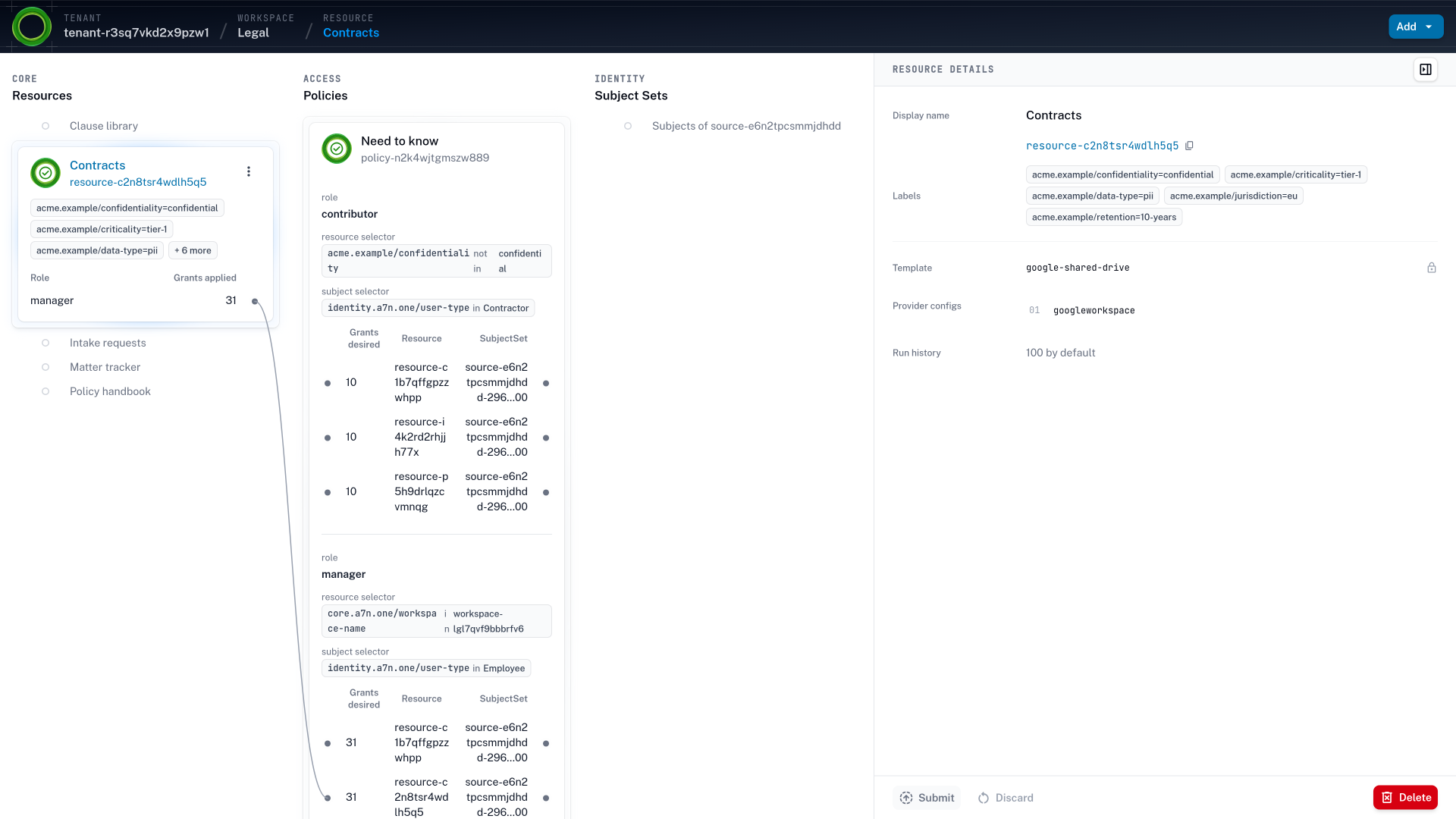
In Accession1 every entitlement is a grant an access policy produced, and no grant exists without one. A reviewer reads a rule, the identities it matches today, the resources it covers, and the facts in the context it rests on, such as the regulation a business unit falls under. The AI assistant answers the questions along the way: who can read the Contracts drive, and which rule grants it. On the Contracts drive that is one question instead of 31 line items: should every employee in Legal manage a confidential drive holding personal data?
Most tools that show you an access graph discover it from audit log events, entitlement crawls, and activity, and infer the desired state from a current state that may already have drifted. In Accession1 the graph is designed, by administrators and workspace members from the context, and it is the desired state every target system is held to, the resource configuration and the access alike. So the reviewer reads the design every system follows, on an inventory current on the review date by construction, and a decision on it changes the systems, not a report.
The same rules cover people, service accounts, and agents, in every system an OpenTofu module connects, so a review of the graph covers every grant from one record, with no entitlement export. Whether the rules are right is still the reviewer’s decision, and it is the only one left.
Automated remediation, between reviews too
A revoke decision in a certification campaign becomes a ticket per target system, and that remediation is where campaigns slip. An auditor asks for evidence of it. In Accession1 a rule changed in the review changes the access everywhere in the next continuous reconciliation, so the remediation is applied rather than ticketed. The same reconciliation runs on every change between reviews, for a person, a pipeline, and an agent alike: a joiner, a mover, or a leaver, a resource provisioned or relabeled, or a rule edited. The transfer, the ended engagement, and the retired pilot that a certification used to find in April revoked their grants the day they happened. So the review starts from the graph, not from a hunt for stale entitlements.
Recent usage is not a reason to keep access
The usual way to shrink the certification is to right-size access to what identities were observed to use, often with AI recommending the removals. Identity security posture management (ISPM) and cloud infrastructure entitlement management (CIEM) tools approach least privilege this way. But usage shows what an identity did, not what it should be able to do. The forecasting pilot’s token passes a usage check, because one agent still calls it. The consultant passes too, a year after the engagement ended, having opened the drive last week. And a coding agent created this morning has no history at all, so a usage-driven process falls back to a ticket.
Recent use doesn’t justify itself. The access may have been meant to end months ago, but nothing took it away. And when nobody can say why an identity holds the access it used last week, revoking it is the step everyone avoids, out of fear of breaking something. So the usage report ends up defending the entitlements it was meant to remove.
In Accession1 the reason is the rule, and the change is the trigger. Every grant names the rule that produced it, so the question is never what the use was for but whether the rule is right. A rule that’s wrong is changed without guessing what depends on it. A new agent gets what its place in the graph calls for before it has used anything, so the restriction is in place before the agent is deployed rather than clawed back after. Least privilege is designed in the workspace and reviewed as rules, for people, service accounts, and agents alike, so no separate review tool is needed for agents.
Audit evidence from the current record
An external auditor asks who can approve payments in the ERP, the expense tool, and the card program. The answer used to take an IT administrator two weeks of exports and a spreadsheet. It was careful and correct, but out of date when it was sent. In Accession1 every grant is an explicit record of an identity, a role, and a resource, and continuous reconciliation keeps that record current. Every resource carries the classification labels your organization settled on, so the Contracts drive says why it is sensitive right next to who can reach it. Where SOX, PCI DSS, HIPAA, or ISO 27001 sets the certification cycle, the certification runs on that cycle. The evidence it produces is the rules reviewed and the grants they produce, with the requirement each rule rests on recorded in the context. Who can approve payments is then one rule and the identities it matches today.